wIf you go into a doctor’s office complaining about constipation, the most common response is “are you getting enough fiber in your diet?”
If you go into that same office complaining about diarrhea, you’ll hear the same refrain, “are you getting enough fiber in your diet?”
This is perplexing as a patient — especially when you consider that increasing your fiber improperly can worsen your GI symptoms.
In this post, we will be explaining what dietary fiber is and how it impacts digestion and ultimately your stools.
A few housekeeping items — I don’t want anybody not seeing a doctor and trying to solve all their problems with fiber:
- See a doctor if you have severe diarrhea, so they can put you on IV fluids.
- If you're really constipated and think you have a fecal compaction (i.e. the stool is basically stuck), you should see a doctor (manual removal being the last resort if you don't respond to laxatives, enemas, etc).
- And lastly, if you are increasing your fiber intake, do so gradually because your body needs time to adjust. Spiking your fiber intake overnight will not result in a good time.
Okay, let’s get into fiber talk.
What is dietary fiber?
Dietary fiber comes from parts of plants that our gut doesn’t break down. Instead of breaking it down, fiber just passes through out system. Fruits, vegetables, grains, legumes, nuts, and seeds all contain fiber. Fiber from plants also makes its way into various processed foods (often as thickeners, emulsifiers, and binding agents).
Fiber is considered a carbohydrate, but because it is not broken down like starches or sugars, it does provide us with any calories.
In the US, the FDA requires that food labels say how much fiber a food contains. There are 2 broad categories of dietary fibers: soluble and insoluble. Despite not being mandated, some producers will specify the amount of soluble fiber1. Confusingly, labels don’t say how much insoluble fiber a food contains, but if you subtract the total dietary fiber from the soluble fiber, the result will be the amount of insoluble fiber.
Let’s take a look at Metamucil — probably the most popular fiber supplement:
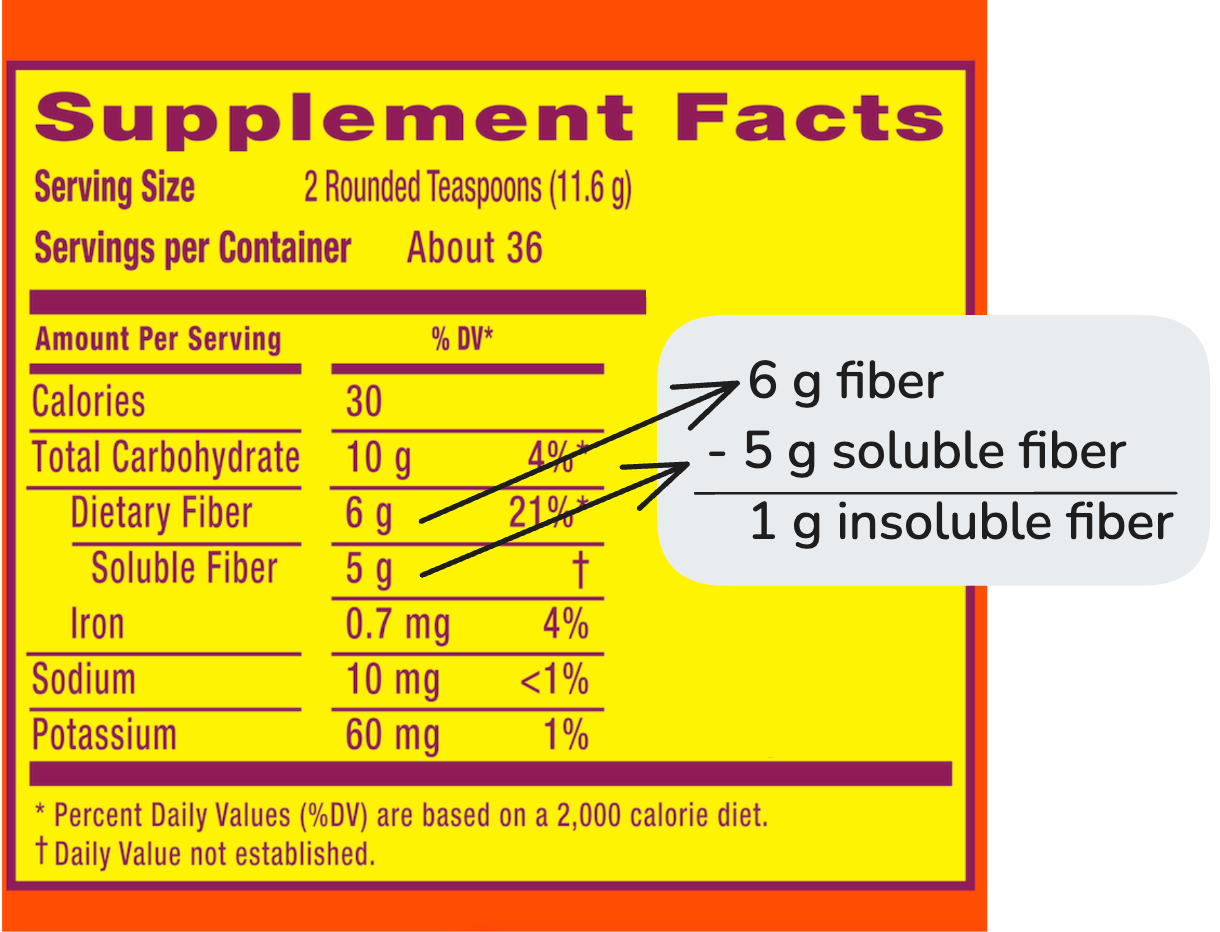
Both types of fiber are said to add “bulk” to your stool, but they do so in different ways. Soluble fiber forms a gel that mixes with your stool. And insoluble fiber remains fully intact in your gut and adds solid roughage to your stool, often stimulating movement.
Basically all plant-based foods we consume have both types of fiber, but the ratio of will vary.
The parts of a plant that will contribute insoluble fiber include rigid sections like the stems, skins, seeds, bran, and tough leaves. These are the structural parts of plants.
The soluble fiber in plants comes from the softer, non-structural parts of plants — think of the inner flesh of bananas, berries, and squash. From the plant’s perspective, the soluble fiber helps the soft, fleshy parts retain water.
Soluble fiber dissolves into gel
As the name suggests, soluble fiber is soluble in water. In other words, when you ingest soluble fiber, it will dissolve into the liquid flowing through you gut and form a gel.
You can imagine if your stools are very liquid (i.e. diarrhea), soluble fiber can be helpful because the gel absorbs that liquid and can slow the passage of diarrhea through your colon. It’s important to note that diarrhea dehydrates you, so hydration is key.
Soluble fiber can also help prevent you from getting too constipated. Because the gel holds onto water and mixes with your existing stool, the stool becomes softer overall. Soft stool is easier to pass than hard stool.
It’s important to increase your water intake when you increase your soluble fiber intake. This is especially important if you’re taking fiber supplements. Otherwise, the gel can become very thick and actually worsen constipation.
Insoluble fiber adds roughage
While I mentioned that soluble fiber helps prevent constipation, it isn’t the best at helping existing constipation — that’s where insoluble fiber may help.
Insoluble fiber does not dissolve in water and does not get broken down in the gut. So pretty much once you chew it up and swallow it, it’s pretty much passing intact through your entire system — I’m looking at you corn.
This intact solid matter is also referred to as roughage. Roughage passes through the system fairly quickly and stimulates the gut to get moving — this is how it can help with existing constipation.
While helpful for constipation, too much insoluble fiber can cause or worsen diarrhea. Try eating a lot of raw cabbage to test this idea. If you have diarrhea, you should probably opt for soluble fiber instead of insoluble fiber.
If you don’t get enough of it in your diet, you can take a fiber supplement. The 3 most common ones are Metamucil, Benefiber, and Citrucel.
Breakdown of fiber supplements
When it comes to what fiber supplement is best, there is no clear cut answer. They're all a little different, so it’s worth trying them to see which works best (that is if you don’t opt to get sufficient fiber through your diet).
A quick Google Trends search reveals Metamucil as the most commonly searched of the 3:
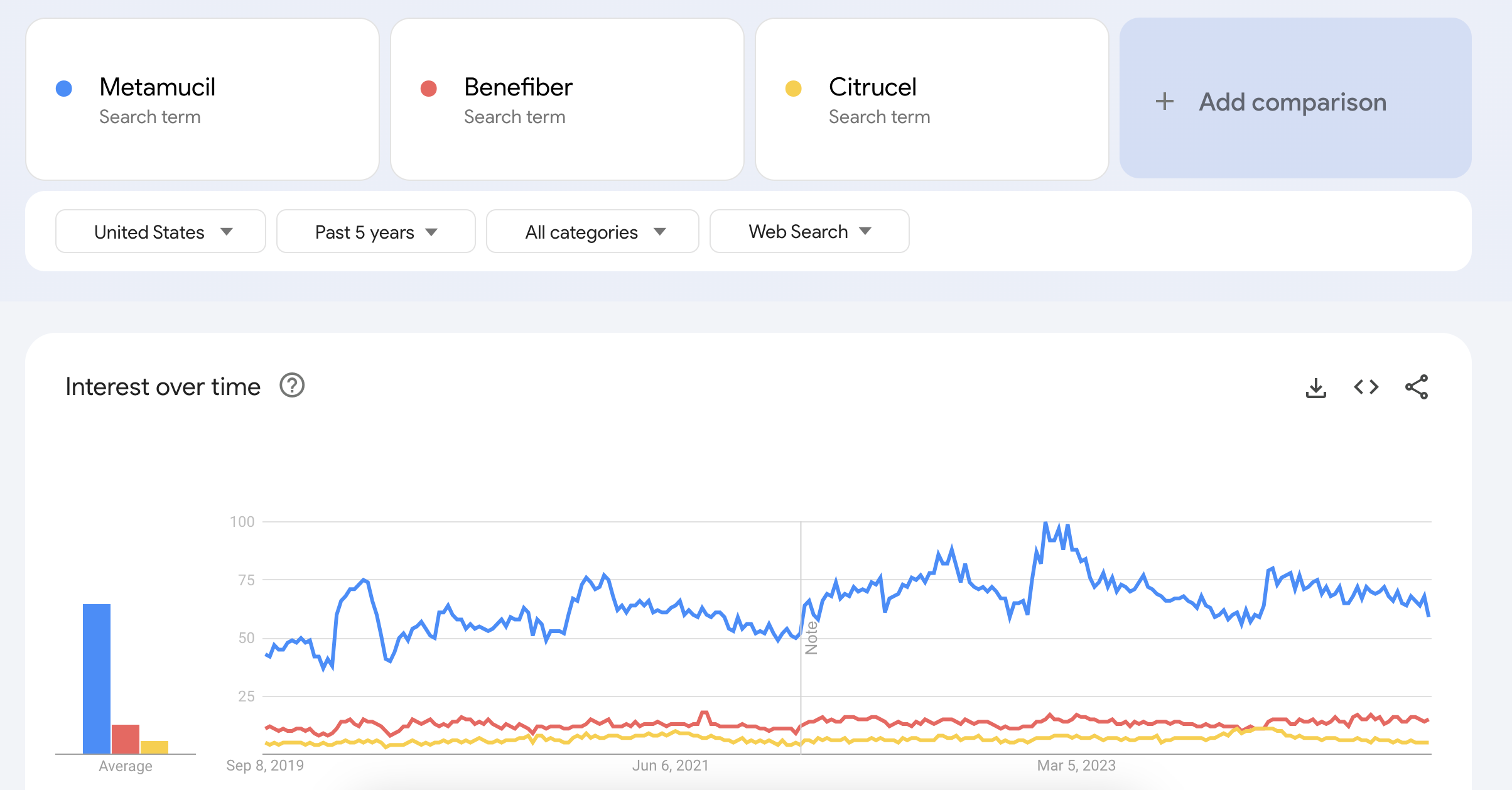
Metamucil is made from psyllium husk, which comes from plants in the “Plantago” genus. When most people think of husk, they think of a corn’s husk. It’s the same idea here just a smaller plant.

As mentioned earlier, Metamucil contains mostly soluble fiber with a little bit of insoluble fiber.
Benefiber
Benefiber (100% soluble fiber) is made out of wheat dextrin — a simple carbohydrate derived from the endosperm of wheat. Dextrin is used in various food and baking applications3.
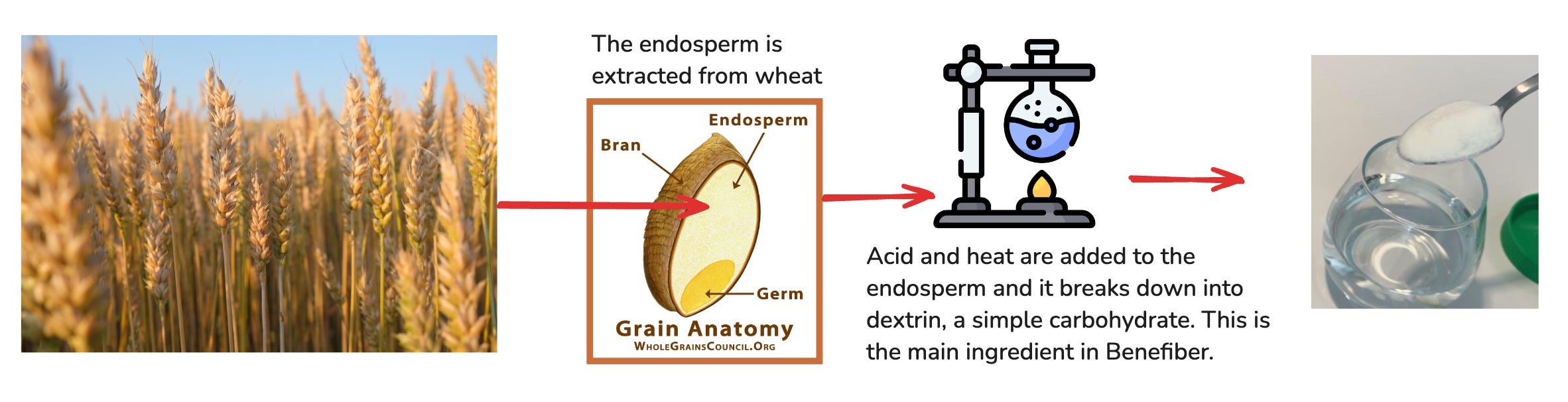
Benefiber only contain soluble fiber. This is evident because when you mix it well into water, the water becomes totally clear.
Citrucel
Citrucel (100% soluble fiber) comes from methylcellulose, a compound that is derived from the abundant organic material, cellulose4.
Cellulose makes up the cell walls of plants. The most common sources of cellulose for production are cotton and wood pulp. The diagram below shows how cotton undergoes multiple physical and chemical processes until we get methylcellulose at the end.
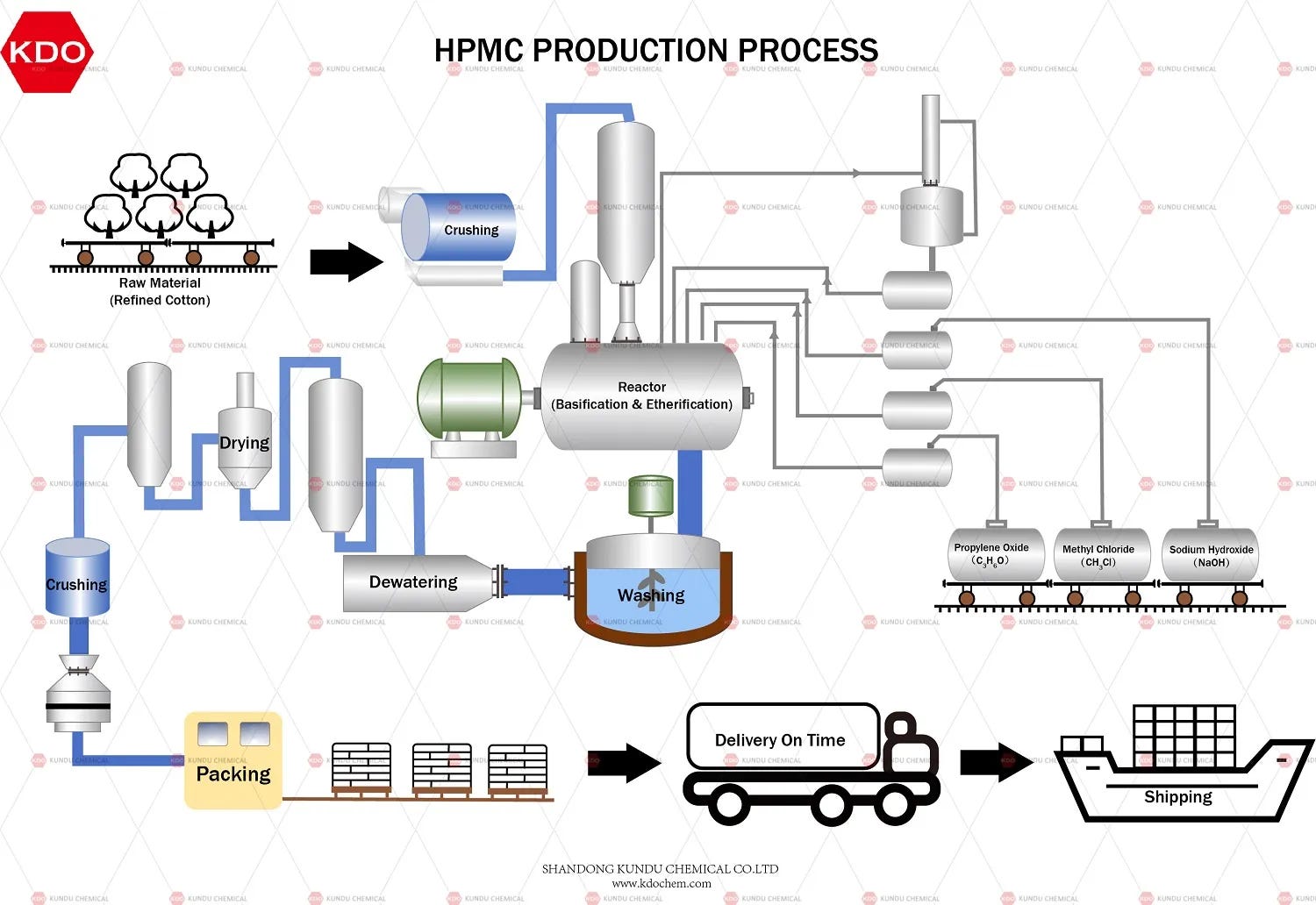
Interestingly, methylcellulose does not ferment in the gut, so people commonly report having less gas when using Citrucel.
Indie Fiber
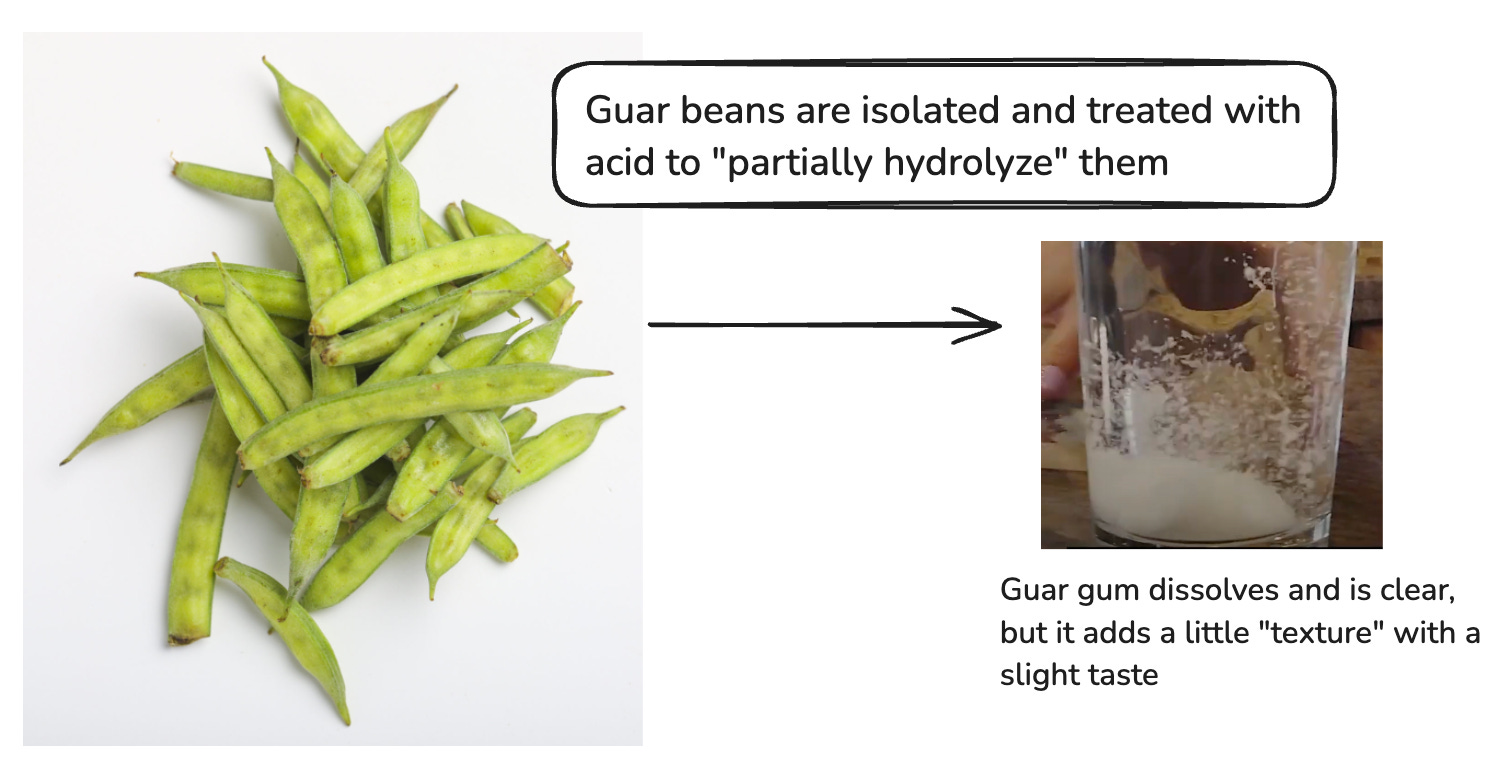
Okay I don’t think anyone calls it “indie fiber” but there are options outside of the big 3 fiber supplements. One example is Sun Fiber, which uses partially hydrolyzed guar gum (100% soluble fiber). I am interested in trying this, but the relative cost is a little steep to justify.
Fiber is complicated
There’s a lot more to fiber than what’s reported on the nutrition label. We didn’t even discuss the different varieties within the soluble (e.g. pectin, inulin, etc.) and insoluble (e.g. cellulose, chitin, etc.) categories. But I hope this post helped you understand the basics of fiber a bit more, so you can make smarter decisions about your gut.